

|
Quantity
|
Out of stock
|
||
|
|
|||
|
|
|||
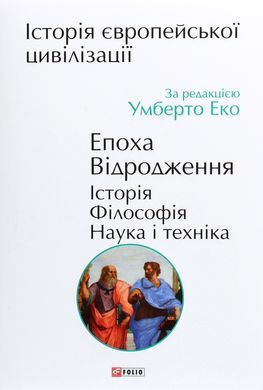
The project "History of European Civilization" covers the period from ancient times to the 20th century and is divided into three main blocks: Antiquity: Rome, Greece, the Middle East; The Middle Ages: Early Middle Ages, High Middle Ages, Late Middle Ages, 15th century; Modernity: 16th-20th centuries. When creating this extraordinary project, its compiler - the outstanding Italian philosopher, literary critic, writer Umberto Eco (1932-2016) - was guided by the multidisciplinary principle: History, Philosophy, Mythology and Religion, Fine Arts, Literature, Science and Technology, Music. Articles for the chapters are written by leading Italian specialists in each field.
The volume "The Renaissance. History. Philosophy. Science and Technology" covers the period of the so-called Cinquecento, that is, it highlights the events that took place in various areas of European civilization during the 16th century. During this period, the formation of the modern State and European identity in the modern sense of the word continues.
The year 1492 is considered the boundary separating the Renaissance from the Middle Ages. It was then that the Reconquista ended, which finally freed Spain from the Moors and the influence of Islam - and this became the beginning of Christian, or the so-called European identity. Another key date of the Cinquecento is 1517, which marks the beginning of the Reformation, which in turn caused the Counter-Reformation, as a result of which the Catholic Church also changed, which could not but affect the strengthening of the positions of science and technology, as well as the development of philosophy and art.
Thus, this volume tells about that period of European history, "when, amidst the germs of renewal and intolerance towards outdated sacred or secular sciences, a new understanding of man and nature was formed, which significantly influenced the modern era."