


|
Quantity
|
Out of stock
|
||
|
|
|||
|
|
|||
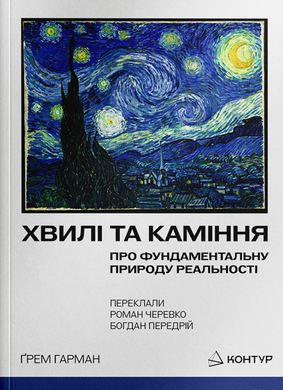
How do we understand the world and our place in it? Does our life consist of a few dramatic turning points, or is it just a series of gradual changes from childhood to old age? Do political elections really change the world, or are they just arbitrary points on a continuous line of cultural shifts? And how does physics reconcile the continuity of general relativity with the discreteness of quantum theory?
In Waves and Stones, Graham Harman shows that this paradoxical clash of two views—whether reality consists of sharp jumps or rather resembles a smooth transition without clear boundaries between things—pervades all areas of human life. Indeed, this paradox has existed since the very beginning of human thought. Exploring the interplay of the continuous and the discrete, the author takes the reader through the history of ideas: from the philosophers of ancient Greece and the works of the great Arab historian Ibn Khaldun to theories of architecture and evolution, from the question of the compatibility of religion and science to the wave-particle duality of matter.
Harman believes that understanding the relationship between the continuous and the discrete involves examining the very fabric of reality. In this brilliant book, he offers a new perspective on an ancient problem that has profound implications for understanding ourselves and the incredibly complex world in which we live.