
|
Quantity
|
Out of stock
|
||
|
|
|||
|
|
|||
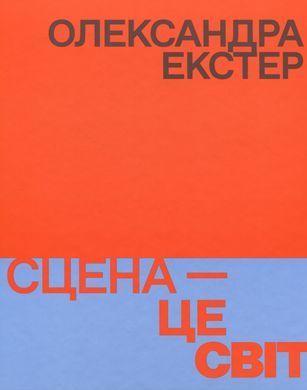
“OLEKSANDRA EXTER: The Stage is the World” is the catalog for the exhibition at the Ukrainian Museum in New York, which opened on September 24 and will run until January 2025. The exhibition features about 40 works by Exter, most from American museums and private collections.
Peter Doroshenko, curator of the exhibition:
“The exhibition of one of the most important artists of the early 20th century, Alexandra Exter, is the first in the Museum’s decolonizing program of presenting Ukrainian art in the United States. Alexandra Exter was a key figure in the development of the Ukrainian avant-garde, working alongside artists such as Kazimir Malevich and Volodymyr Tatlin. Her participation in these movements helped shape the course of Ukrainian art in the early 20th century, but her contribution is often overshadowed by her Russian contemporaries. By highlighting Exter’s role in Ukrainian contemporary art, we can challenge the Russian narrative of modernism and demonstrate the diversity of artistic innovation taking place in Ukraine at this time.
Exter’s work is often classified as Cubo-Futurism, a movement that combined elements of Cubism and Futurism to create dynamic and abstract compositions. Her work was influenced by her Ukrainian heritage, as well as her exposure to European modernist movements while living in Paris. However, despite her Ukrainian origins, Exter’s work has remained largely invisible in art history, and her contributions to Ukrainian art and culture have received little attention. The exhibition “Olexandra Exter: The Stage is the World” covers the six years of her work in Ukraine before her participation in the film “Aelita” and her move to France, as well as the next six years of her work in Paris.”
And in total, Alexandra lived in Ukraine for more than 35 years of her life.
Here, Alexandra graduated from St. Olga's Gymnasium, studied at the Kyiv Art School, married Mykola Ekster and lived with her husband and his parents at 1 Gimnaziynaya Street (now Leontovycha Street), opening a Painting Workshop, where Vadim Meller, Anatoly Petrytsky, Oleksandr Tishler, Oleksandr Khvostenko-Khvostov, Isaak Rabinovich, Kliment Redko and others studied and communicated. Alexandra Ekster and her Studio had a powerful influence on the creative life of the city. Together with Oleksandr Bogomazov, Ekster organized exhibitions of new art in Kyiv — the famous "Ring" and "Lanka", which were among the first in the then empire. Contemporaries wrote that all the leftist artists of Kyiv came out of her studio, and researchers claim that the avant-garde line of Ukrainian scenography originated in Alexandra Exter's theater.
In Kyiv, Exter collaborated with Bronislava Nizhynska's ballet "School of Movement". At the current National Museum of Art, she worked as a co-curator and exhibition designer for the 1906 folk art exhibition. And how much did Alexandra do to research and combine folk art with the avant-garde, folk craftswomen and modernists - collaborating with the peasant workshops of Davydova in Verbivka and Semigradova-Prybylska in Skoptsy. As a scenographer, she created hundreds of performances, and it was these, along with her works, that brought her world recognition. After moving to France in 1924, she also worked in fashion, creating fabrics and interiors. "She traveled a lot, lived for a long time in Paris and Moscow, in Rome and St. Petersburg. However, she always returned to Kyiv: here was her home, her workshop, her famous studio. And when she had to leave Kyiv forever, she would furnish her Parisian house exactly like her Kyiv one."