

|
Quantity
|
Out of stock
|
||
|
|
|||
|
|
|||
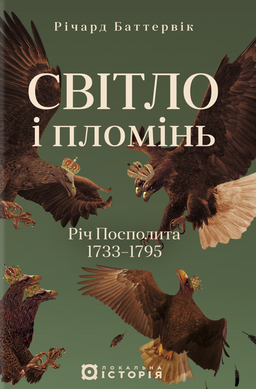
In his book “Light and Flame: The Polish-Lithuanian Commonwealth, 1733–1795,” British historian Richard Butterwick reconstructed the last decades of the Polish-Lithuanian Commonwealth, a European multinational state long considered weak and ailing. After its first partition among its neighbors, it attempted to break free from Russian influence and demonstrated its ability to politically renew itself and overcome social and religious constraints. However, the Polish-Lithuanian Commonwealth’s correct, albeit belated, aspirations to modernize and restore sovereignty ran counter to the interests of the Russian Empire, Prussia, and Austria, which ultimately tore it apart. After the annexation of the most fertile lands and a new outbreak of resistance, Catherine II ordered the final liquidation of the state, declaring that the empire was merely “reclaiming the Russian heritage.”
“Light and Flame” tells the story of a little-known period of our history from the Ukrainian perspective — from the interregnum of 1733 to the third partition of the Polish-Lithuanian Commonwealth in 1795, which often remains in the shadow of the Hetmanate and the nation-building of the 19th century. Butterwick pays special attention to Right-Bank Ukraine, which in the 18th century became an arena of reforms, demographic growth, and social and religious transformations.
For the Ukrainian reader, this book is an incentive to rethink the Polish-Lithuanian Commonwealth as part of their own history. And in the end, no honest answer to the question “Why are Ukrainians not Russians?” can bypass our place in this state.